


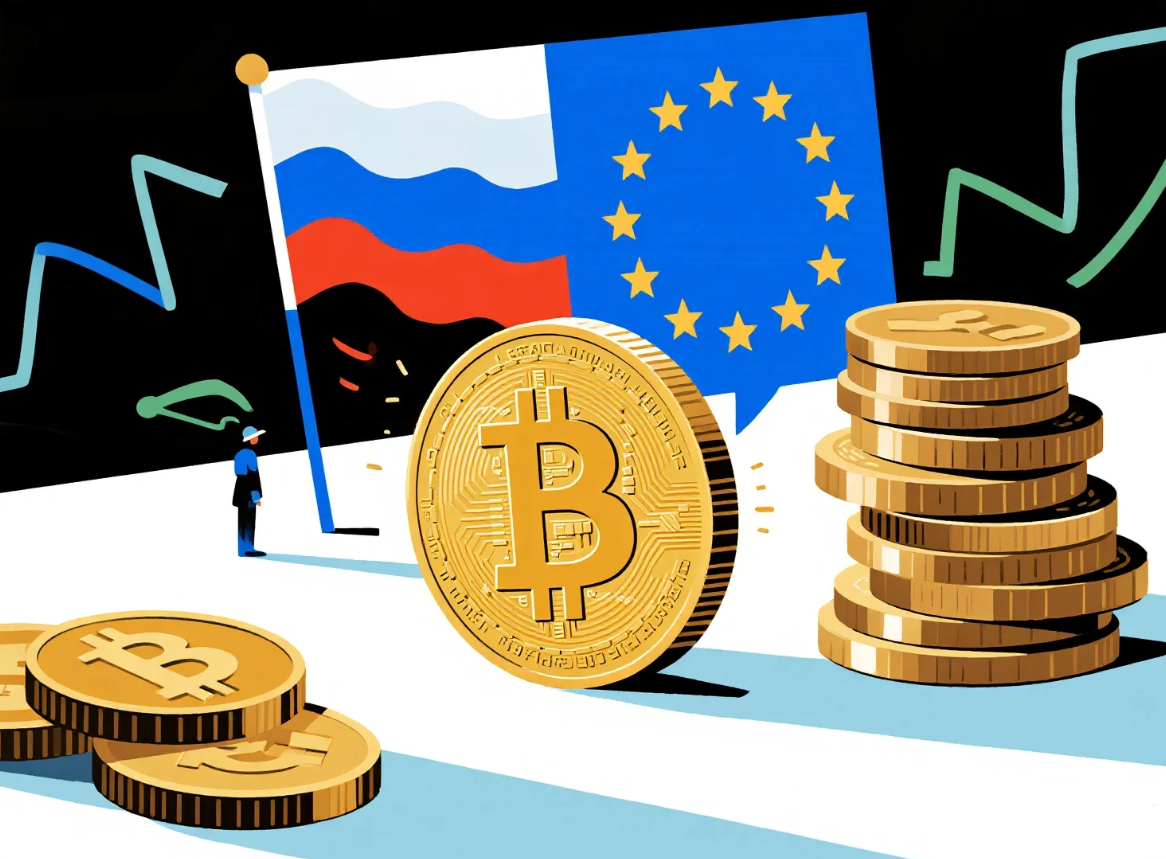

What’s called “crypto regulation” in Russia, the EU, and Hong Kong is actually three fundamentally different projects.
1. One-Sentence Conclusion (The Core Difference)
- Russia: Treats crypto as a national tool for sanctions evasion and cross-border settlement.
- EU (MiCA): Treats crypto as a financial product focused on consumer protection and market integrity.
- Hong Kong (VA regime): Treats crypto as a financial industry aimed at attracting capital and institutional players.
This is not a difference in regulatory intensity—it’s a difference in strategic positioning.
2. Russia: “A State-Controlled Crypto Toolkit”
Key Institutional Facts (Based on Disclosed Legislation)
- Legislative body: Russian State Duma
- Key figure: Anatoly Aksakov
- Expected effective date: July 1, 2027
- Core provisions:
- Unregistered exchanges → fines or criminal liability
- Retail investors:
- Must pass a qualification test
- Annual purchase limit: $4,000
- Allowed assets: Determined by the Central Bank (likely only BTC/ETH)
- Stablecoins:
- Primarily for foreign economic activity
- Only accessible via licensed brokers
Russia’s Real Objectives
The goal is not to develop a vibrant crypto market, but three strategic priorities:
- Sanctions circumvention
- SWIFT restrictions and blocked forex channels
- Stablecoins viewed as alternative settlement pipelines
- Prevent capital flight
- Strict quotas
- Ban on large retail allocations
- Central Bank-controlled asset whitelist
- Integrate crypto into the national financial order
- No encouragement of DeFi
- No support for anonymous on-chain finance
- No free token listings
Russia’s crypto is a state-deployed financial technology, not a free civilian market.
3. EU MiCA: “Financial Compliance + Consumer Protection First”
Key Institutional Facts (MiCA Framework Now in Effect)
- Regulation: Markets in Crypto-Assets (MiCA)
- Coverage: All 27 EU member states
- Primary targets:
- Stablecoins (ARTs and EMTs)
- Crypto-asset issuers
- Crypto-asset service providers (CASPs)
Core MiCA requirements:
- Stablecoins must:
- Disclose reserve composition
- Undergo regulatory audits
- Provide redemption guarantees
- Exchanges must:
- Meet capital requirements
- Provide risk disclosures
- Segregate client assets
The EU’s Real Goals
The EU does not care whether you make money—it cares about three things only:
- Consumers must not suffer systemic harm
- The broader financial system must not be exposed to contagion
- Regulation must be uniform across the bloc, not fragmented
MiCA’s essence: Turn crypto assets into regulatable financial instruments.
Real-World Examples (EU Logic in Action)
- Multiple stablecoin issuers forced to adjust reserves or restrict non-euro stablecoins in payments
- Some exchanges exited the EU market or restricted products due to non-compliance
It’s not prohibition—it’s “fail the standard, and you can’t operate.”
4. Hong Kong VA Regime: “Financial Hub Path to Crypto Industrialization”
Key Institutional Facts
- Regulator: Securities and Futures Commission (SFC)
- Regime: Virtual Asset Service Provider (VASP) licensing
- Core features:
- Licensing system
- Retail participation allowed (under compliance)
- Encourages institutions, ETFs, custody
Hong Kong’s Real Goals
Hong Kong’s policy is fundamentally about integrating crypto into the financial industry under controlled risk.
This manifests as:
- Approval of Bitcoin and Ethereum ETFs
- Encouragement of custody, trading, asset management, and market-making
- Alignment with traditional finance (brokers, banks)
Real-World Examples (Hong Kong Path)
- Multiple global exchanges have applied for or obtained VA licenses
- Launch of spot Bitcoin and Ethereum ETFs
- Explicit permission for compliant retail participation and institutional-grade products
Hong Kong is not “using crypto”—it is building a crypto business.
5. Comparison Table: The Essential Differences
| Dimension | Russia | EU (MiCA) | Hong Kong (VA) |
|---|---|---|---|
| Core Objective | National tool | Financial compliance | Financial industry |
| Retail Participation | Severely restricted | Allowed but protected | Explicitly allowed |
| Asset Selection | Central Bank whitelist | Market + compliance | Mainstream priority |
| Stablecoin Role | Cross-border settlement | Financial product | Investment/payment tool |
| Attitude to DeFi | Indifferent/restricted | Highly cautious | Indirectly accommodated |
| State Role | Dominator | Rule-setter | Market facilitator |
6. Key Takeaways for Investors (Very Important)
Long-term trend
- BTC and ETH are being institutionally legitimized in all three systems—just via different routes.
Altcoins and DeFi
- Russia: Virtually no room
- EU: Prohibitively high compliance costs
- Hong Kong: Only viable for top-tier, institutional-grade projects
Macro perspective Crypto is being absorbed into national financial systems, not eradicated.
7. One-Sentence Ultimate Summary
Russia is using crypto, the EU is regulating crypto, Hong Kong is building a crypto business.
Understand this, and you’ll stop interpreting policies through the outdated lens of “bullish/bearish.”
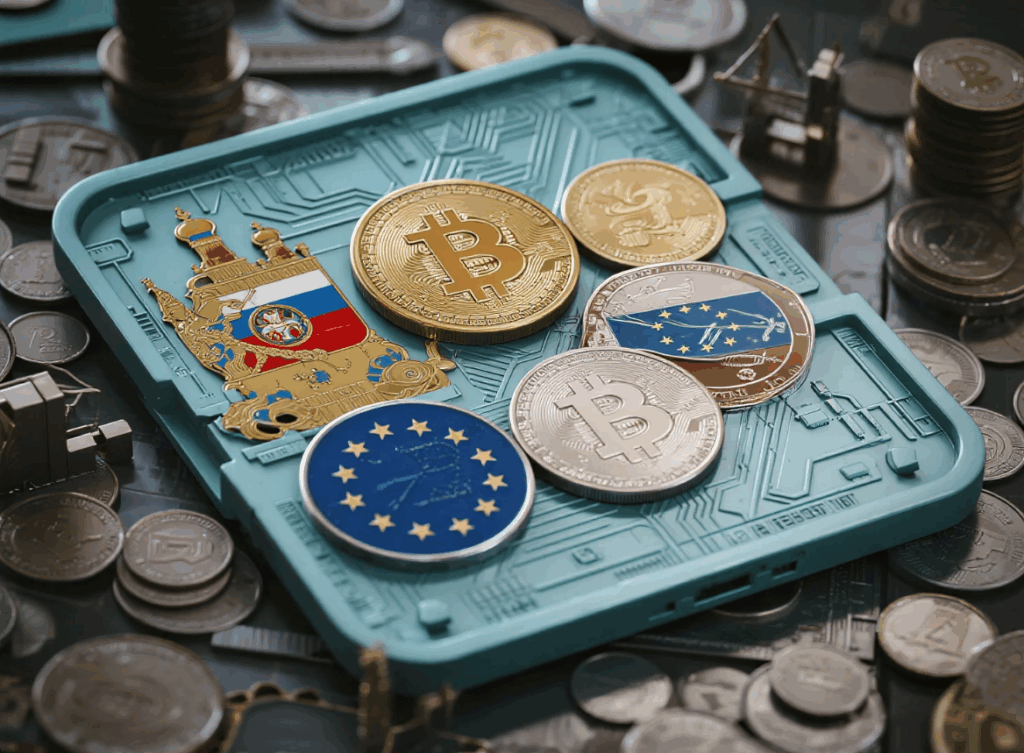
Why National Adoption of Stablecoins May Crowd Out Private Ones
1. An Overlooked Reality
At the state level, stablecoins are valued not for investment yield, DeFi composability, or decentralization narratives, but for three mundane attributes:
- Settlement efficiency
- Controllability
- Regulatory oversight
Once stablecoins enter national use, the evaluation criteria change completely.
2. When States Enter, the Rules Get Rewritten
Old paradigm (private stablecoin era) Competitive edge came from ease of use, borderless flow, on-chain composability, and neutrality.
Typical examples: USDT, USDC
New paradigm (state involvement) Value is judged by traceability, freeze/rollback capability, compliance with capital controls, and integration into central bank/treasury systems.
These requirements directly conflict with the original advantages of private stablecoins.
3. First-Order Squeeze: Compliant Stablecoins Marginalize Free Ones
When states permit stablecoins for trade settlement, energy payments, or corporate clearing, they typically impose:
- Designated issuers
- Designated chains
- Designated use cases
- Designated compliance paths
Result: “Official” stablecoins become the default; private ones get labeled high-risk or non-mainstream.
Real-world precedent: In some jurisdictions, banks and corporations are restricted to regulated stablecoins and barred from unregulated issuers—even if the latter are technically superior.
4. Second-Order Squeeze: States Won’t Tolerate Stablecoins Bypassing Monetary Systems
Widespread private stablecoin adoption risks:
- Local currency displacement
- Harder capital controls
- Weaker monetary policy transmission
- Regulatory blind spots
Thus, when states adopt stablecoins themselves, the logic is often: “I can use it—you cannot use it freely.”
This manifests as retail limits, use-case restrictions, strict KYC, and on-chain monitoring—directly eroding the free-circulation value of private stablecoins.
5. Third-Order Squeeze: Trust Anchor Shifts to State Backing
Private stablecoins rely on reserve transparency, redemption history, scale, and network effects.
State-backed or state-approved stablecoins derive trust from national credit, legal enforceability, and regulatory guarantees.
Users naturally gravitate toward the “safer,” state-endorsed option—even if it is less convenient or DeFi-incompatible.
6. Fourth-Order Squeeze: Compliance Costs Kill Small Players
State adoption brings higher audit frequency, stricter reserve rules, heavier disclosure, and greater legal liability.
Only massive, well-capitalized issuers survive. Smaller private stablecoins are forced to exit, go underground, or fail.
7. A Critical Structural Shift: Use-Case Bifurcation
The future likely splits stablecoins into two tracks:
Institutional/State-Approved Stablecoins
- Used for trade settlement, corporate payments, inter-institutional clearing
- High compliance, high control, low freedom
Private Stablecoins
- Confined to on-chain, niche, or gray-market use
Mainstream capital will clearly favor the former.
8. Are Private Stablecoins Doomed?
Not entirely—but their role will shrink dramatically.
They can still survive in:
- Internal DeFi settlement
- High-risk-preference users
- Extreme decentralization scenarios
They can no longer realistically aspire to:
- Becoming universal digital dollars
- Replacing fiat systems
- Mainstream payment adoption
9. One-Sentence Ultimate Summary
When states begin using stablecoins, they cease to be anti-system tools and become part of the system—and systems instinctively compress the space for unofficial, uncontrollable, competing monies.
This is not conspiracy; it is the natural outcome of state financial logic.
FAQ
Q: Since Hong Kong is building a crypto business, can ordinary people open accounts? A: Yes. On platforms holding an SFC-issued VATP license (currently around 11), retail investors can legally trade BTC and ETH after passing an investor knowledge assessment.
Q: How do Russia’s new crypto rules affect me? A: Direct impact is minimal if you’re outside Russia. Macro-level, it proves crypto can serve as infrastructure for non-USD payment systems, accelerating global “de-dollarization” experiments.
References
- EU official summary: https://finance.ec.europa.eu/regulation-and-supervision/financial-services-legislation/crypto-assets_en
- Hong Kong SFC official documents: https://www.sfc.hk/en/Regulatory-functions/Fintech/Virtual-assets
- $100 Bitcoin — Profit Calculator & Examples:https://btcprofitcalculator.com/scenarios/bitcoin-profit-calculator-100
- BIS report “Global Stablecoins: Risks and Opportunities”: https://www.bis.org/publ/qtrpdf/r_qt2003j.htm


